
Guest Post
Ensuring a Successful Systems Implementation

Rhiannon Gibbs
Director at Ad Esse Consulting
Systems and technology are truly wonderous; there are almost unlimited possibilities and opportunities for making our lives better. However, most organisations pursuing new technology can’t describe a successful outcome for their last system implementation (new CRM system anyone?), which begs the following questions – what is going wrong? And why would things be different this time?
Many organisations implement new systems with the aims of becoming more efficient, and to reduce the errors in their work. Unfortunately, their starting position is with poor, error-prone, undocumented, and non-standardised processes and data. It is assumed that implementing a system will fix this. It won’t! And in the bottom of your heart, you know it won’t!
If you start designing a system around poor, non-standardised ways of working, or simply design your system around how things ‘should work’ (but the reality is that they have never worked that way), your system implementation will fail.
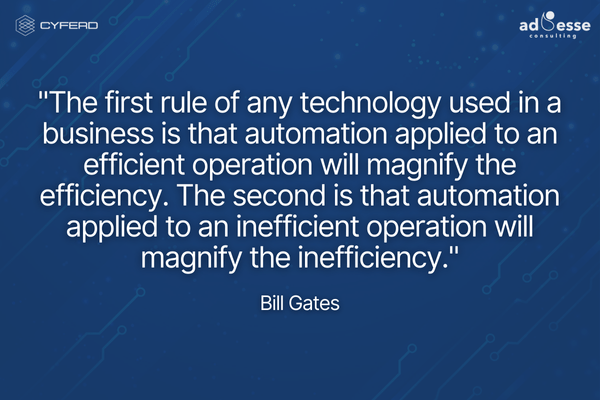
Bill Gates summed this up best when he said:
You must have robust, value-adding processes and working practices in place BEFORE you introduce any technological enhancement to drive further efficiencies. If you’re wondering why your transformations (of any kind) aren’t delivering results, take our free Transformation Health-Check [here].
Whilst most organisations know how to implement an IT system, they don’t know how to design good processes and change the way people do things day-to-day. So, what happens is decision makers put their heads in the sand and pretend that millions spent (wasted) on IT systems are justified because they perceive that not having the systems puts them ‘behind the curve’.
You’ve probably heard the phrase, ‘no one gets fired for hiring McKinsey.’ Well, it seems no-one gets fired for rolling out MS Dynamics.
It’s time to call out and change these practices. If you are implementing an IT system and you haven’t already got good working processes and practices in place, you are wasting money. If you are in the public, charity or not-for profit sectors then it’s not money from shareholders’ pockets you’re wasting, it’s money from taxpayers, tenants, donors, or members of the public.
The digital angle plays an important part of any transformation, but it’s an enabler of better services, not the objective of your transformation. Read that sentence again and let it really sink in. Anyone who has a digital transformation underway now needs to take a step back and ask themselves “what is the driver for the ‘digital’ transformation” and then consider re-naming their efforts. Please let us never see ‘implement AI’ as a blanket statement in a strategy document again!
‘Technology first’ is dead! The new world, where we can better utilise the capabilities that technology can offer, is to accept the tech for what it is, an enabler, and to take a purpose centric ‘service design’ view first.
Learn more about Ad Esse Consulting [here] or fill in the form below to get started.
Find out more About Cyferd

New York
Americas Tower
1177 6th Avenue
5th Floor
New York
NY 10036
London
2nd Floor,
Berkeley Square House,
Berkeley Square,
London W1J 6BD
Request a Demo
Comparisons
BOAT Platform Comparison 2026
Timelines and pricing vary significantly based on scope, governance, and integration complexity.
What Is a BOAT Platform?
Business Orchestration and Automation Technology (BOAT) platforms coordinate end-to-end workflows across teams, systems, and decisions.
Unlike RPA, BPM, or point automation tools, BOAT platforms:
- Orchestrate cross-functional processes
- Integrate operational systems and data
- Embed AI-driven decision-making directly into workflows
BOAT platforms focus on how work flows across the enterprise, not just how individual tasks are automated.
Why Many Automation Initiatives Fail
Most automation programs fail due to architectural fragmentation, not poor tools.
Common challenges include:
- Siloed workflows optimised locally, not end-to-end
- Data spread across disconnected platforms
- AI added after processes are already fixed
- High coordination overhead between tools
BOAT platforms address this by aligning orchestration, automation, data, and AI within a single operational model, improving ROI and adaptability.
Enterprise BOAT Platform Comparison
Appian
Strengths
Well established in regulated industries, strong compliance, governance, and BPMN/DMN modeling. Mature partner ecosystem and support for low-code and professional development.
Considerations
9–18 month implementations, often supported by professional services. Adapting processes post-deployment can be slower in dynamic environments.
Best for
BPM-led organizations with formal governance and regulatory requirements.
Questions to ask Appian:
- How can we accelerate time to production while maintaining governance and compliance?
- What is the balance between professional services and internal capability building?
- How flexible is the platform when processes evolve unexpectedly?
Cyferd
Strengths
Built on a single, unified architecture combining workflow, automation, data, and AI. Reduces coordination overhead and enables true end-to-end orchestration. Embedded AI and automation support incremental modernization without locking decisions early. Transparent pricing and faster deployment cycles.
Considerations
Smaller ecosystem than legacy platforms; integration catalog continues to grow. Benefits from clear business ownership and process clarity.
Best for
Organizations reducing tool sprawl, modernizing incrementally, and maintaining flexibility as systems and processes evolve.
Questions to ask Cyferd:
- How does your integration catalog align with our existing systems and workflows?
- What is the typical timeline from engagement to production for an organization of our size and complexity?
- How do you support scaling adoption across multiple business units or geographies?
IBM Automation Suite
Strengths
Extensive automation and AI capabilities, strong hybrid and mainframe support, enterprise-grade security, deep architectural expertise.
Considerations
Multiple product components increase coordination effort. Planning phases can extend time to value; total cost includes licenses and services.
Best for
Global enterprises with complex hybrid infrastructure and deep IBM investments.
Questions to ask IBM:
- How do the Cloud Pak components work together for end-to-end orchestration?
- What is the recommended approach for phasing implementation to accelerate time to value?
- What internal skills or external support are needed to scale the platform?
Microsoft Power Platform
Strengths
Integrates deeply with Microsoft 365, Teams, Dynamics, and Azure. Supports citizen and professional developers, large connector ecosystem.
Considerations
Capabilities spread across tools, requiring strong governance. Consumption-based pricing can be hard to forecast; visibility consolidation may require additional tools.
Best for
Microsoft-centric organizations seeking self-service automation aligned with Azure.
Questions to ask Microsoft:
- How should Power Platform deployments be governed across multiple business units?
- What is the typical cost trajectory as usage scales enterprise-wide?
- How do you handle integration with legacy or third-party systems?
Pega
Strengths
Advanced decisioning, case management, multi-channel orchestration. Strong adoption in financial services and healthcare; AI frameworks for next-best-action.
Considerations
Requires certified practitioners, long-term investment, premium pricing, and ongoing specialist involvement.
Best for
Organizations where decisioning and complex case orchestration are strategic differentiators.
Questions to ask Pega:
- How do you balance decisioning depth with deployment speed?
- What internal capabilities are needed to maintain and scale the platform?
- How does licensing scale as adoption grows across business units?
ServiceNow
Strengths
Mature ITSM and ITOM foundation, strong audit and compliance capabilities. Expanding into HR, operations, and customer workflows.
Considerations
Configuration-first approach can limit rapid experimentation; licensing scales with usage; upgrades require structured testing. Often seen as IT-centric.
Best for
Enterprises prioritizing standardization, governance, and IT service management integration.
Questions to ask ServiceNow:
- How do you support rapid prototyping for business-led initiatives?
- What is the typical timeline from concept to production for cross-functional workflows?
- How do licensing costs evolve as platform adoption scales globally?
