
Business
The 8 Stages of AI Adoption: A Change Curve Guide
Or as we like to call it—“Good Grief! The 8 Stages of AI Adoption”
Introduction
Change is never easy—especially when it involves disruptive technologies like artificial intelligence (AI). As organizations race to stay competitive in a digital-first world, AI adoption has become a critical priority. But while the focus is often on tools and infrastructure, the human element is just as vital.
To successfully navigate this transformation, it helps to understand the emotional and psychological journey teams experience. One model that offers deep insight is the Kübler-Ross Change Curve. Originally developed to explain the five stages of grief, this framework has evolved into a valuable tool for managing organizational change—particularly when implementing transformative technologies like AI.
For leaders navigating this journey, we’ve mapped “The 8 Stages of AI Adoption” to the Change Curve; so you can guide your team with clarity, not guesswork.
Section 1: Understanding the Kübler-Ross Change Curve
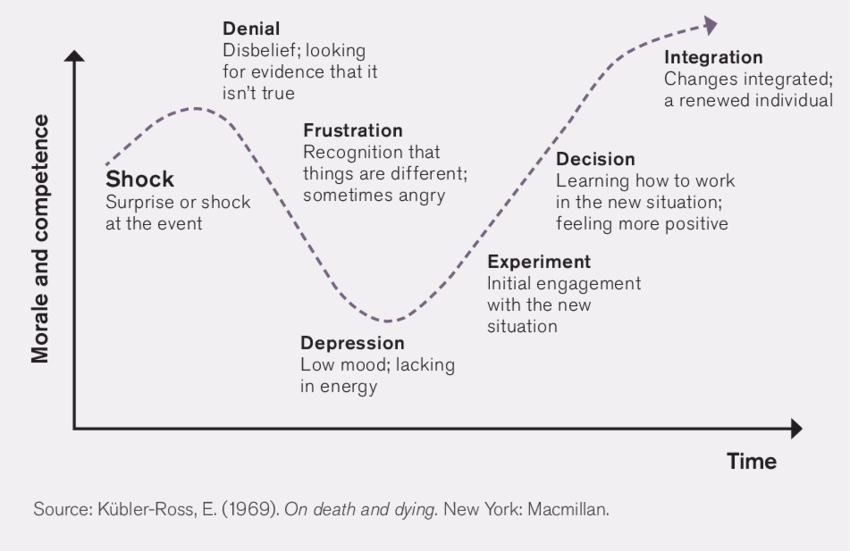
The Kübler-Ross Change Curve is based on the work of psychiatrist Elisabeth Kübler-Ross, who introduced the five stages of grief—denial, anger, bargaining, depression, and acceptance—in her 1969 book On Death and Dying. Originally developed to describe the emotional responses of individuals facing terminal illness, the model has since been adapted to a broader context: understanding how people emotionally respond to significant change.
Over time, this framework evolved beyond the medical and personal realms to become a powerful tool in change management. Business leaders, psychologists, and consultants began applying the curve to organizational transformation, where emotional resistance, uncertainty, and adaptation follow strikingly similar patterns.
To better align with business realities, additional stages have been added:
- Experimentation: Individuals begin testing or engaging with the new change in small ways.
- Decision: Teams commit to the new approach or tool after seeing value.
- Integration: The change becomes part of daily life, fully embedded into the organization’s culture and workflows.
This extended model is particularly useful for navigating complex transformations like digital modernization, cloud migration, or AI adoption; where the emotional journey is just as critical as the technical rollout.
Whether it’s using AI to automate manual admin tasks or moving from a patchwork of tools to a unified data platform, change at this scale requires more than just new tools. It requires a deep understanding of how people experience and adapt to transformation.
Section 2: The Stages of the Change Curve in AI Adoption
1. Shock and Denial
What It Looks Like:
When AI is first introduced, skepticism dominates. Employees may downplay its importance, ignore documentation, or treat it as a passing trend. Leaders might hear things like, “AI won’t really affect our team,” or “It’s just another buzzword.”
Example:
A retail company introduces AI-powered inventory tools, but frontline managers continue to use their Excel spreadsheets, assuming the new tech is overly complex or temporary.
Leader’s Strategy:
Transparency reduces fear. Share clear messages about why AI is being introduced, what specific problems it will solve, and how it supports the business strategy. Don’t flood people with technical details—focus on the purpose and ease the team in gradually.
2. Anger
What It Looks Like:
As the reality of change sets in, frustration can emerge. Employees may fear job loss or feel their expertise is being undervalued. Resistance becomes more vocal, and morale may dip as existing routines are disrupted.
Example:
Customer service agents voice strong opposition to AI chatbots, worried their roles will become obsolete or that the AI will introduce errors that impact customer satisfaction.
Leader’s Strategy:
Acknowledge the emotional impact and validate concerns. Create spaces for open dialogue, address misconceptions, and involve employees in shaping how AI is implemented. Make it clear that AI is here to assist, not replace, human contributions.
3. Bargaining
What It Looks Like:
Teams begin looking for a compromise or limited engagement. Instead of full-scale adoption, they prefer to “test the waters” with minimal disruption. This often includes pilot programs or constrained use cases.
Example:
The HR team agrees to try AI-driven resume screening, but only for internship roles, while continuing to manually review all other applicants.
Leader’s Strategy:
Use this stage as an opportunity. Let teams experiment in safe, low-risk environments while building confidence. Share early wins from these pilot efforts to demonstrate real value and nudge teams toward broader adoption.
4. Depression
What It Looks Like:
This is the “low point” in the change journey. Fatigue, confusion, and self-doubt become common. Employees may feel overwhelmed by the learning curve or unclear about how their roles will evolve in an AI-driven environment.
Example:
A finance team undergoing a system overhaul feels increasingly demoralized as they juggle month-end reporting with AI training sessions, unsure how their responsibilities will change long-term.
Leader’s Strategy:
Step in with extra support. Offer hands-on training, mentoring, and positive reinforcement. Reinforce the “why” behind the change and share relatable success stories to help teams visualize a future where they thrive with AI.
5. Acceptance
What It Looks Like:
Gradually, resistance eases. Teams begin to see AI as a helpful tool rather than a threat. Engagement with training materials increases, and employees start asking how AI can improve their own workflows.
Example:
The compliance team, initially hesitant, begins using AI to flag anomalies in documentation and realizes it saves hours of manual review.
Leader’s Strategy:
This is the turning point. Build momentum. Encourage curiosity, spotlight enthusiastic adopters, and offer continuous learning opportunities. Make room for feedback to further refine adoption.
Section 3: Moving Beyond Acceptance
Experimentation, Decision, and Integration in AI Adoption
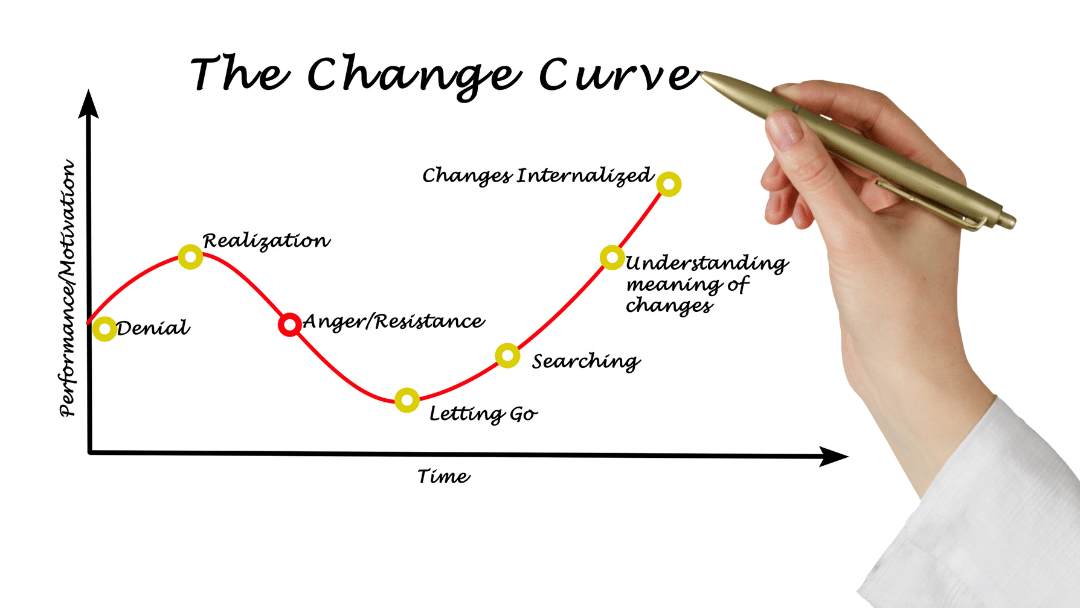
While acceptance is a major turning point in the change journey, it’s not the finish line. To truly realize the value of AI, organizations need to move beyond passive acceptance and into active engagement. That’s where the extended stages of the Change Curve come in: Experimentation, Decision, and Integration.
These final stages are where transformation takes root—not just in processes, but in mindsets and culture.
6. Experimentation
What It Looks Like:
After accepting that AI is here to stay, curiosity starts to emerge. Teams begin exploring what AI can do—running pilots, attending workshops, or dabbling in low-risk use cases. There’s a shift from passive tolerance to cautious engagement.
Example:
The marketing team starts using AI to generate social media captions and A/B test subject lines. The legal team pilots AI to summarise standard contracts. It’s early days, but the willingness to try is growing.
Leader’s Strategy:
Encourage safe-to-fail experiments. Frame this phase as a sandbox for learning, not evaluation. Provide access to tools, training, and internal champions who can help troubleshoot and share success stories. Celebrate early wins, no matter how small, to build confidence.
7. Decision
What It Looks Like:
After testing and seeing some results, teams start making choices. What AI tools align with their goals? Which workflows should change? Who needs upskilling? This is a strategic turning point where leadership and teams move from experimentation to commitment.
Example:
The IT team that piloted AI-powered anomaly detection for system logs decides to adopt it more widely after noticing fewer downtime incidents and faster resolutions.
Leader’s Strategy:
Facilitate informed decision-making. Bring in data from pilots, user feedback, and industry benchmarks. Offer support for selecting tools that align with business objectives. Encourage cross-functional input to ensure buy-in across departments.
8. Integration
What It Looks Like:
AI becomes part of business as usual. It’s no longer a side project—it’s embedded in workflows, conversations, and culture. Employees know how to use it, and leadership is actively looking for new ways to enhance operations through AI.
Example:
Sales teams use AI to qualify leads and suggest next-best actions. HR relies on AI to track employee sentiment. Teams across the business expect AI to be part of how work gets done.
Leader’s Strategy:
Promote a culture of continuous improvement. Make AI usage visible, recognized, and rewarded. Invest in long-term training and governance to support responsible AI use. Ensure that processes evolve alongside technology to avoid stagnation.
Section 4: Practical Tips for Guiding Your Team Through the Change Curve
Supporting your team through the emotional and psychological journey of AI adoption requires more than a technical rollout. It’s about building trust, enabling growth, and leading with empathy. Here are four practical strategies to guide your organization through each stage of the Change Curve:
1. Communicate Transparently and Often
People don’t fear change as much as they fear the unknown. That’s why clear, consistent communication is your first and most powerful tool.
What to do:
- Explain why AI adoption is happening—link it to business goals, competitive advantage, or customer value.
- Set realistic expectations about timelines, benefits, and challenges.
- Acknowledge anxieties like job displacement, skill gaps, or workflow disruption. Ignoring these only deepens resistance.
As Trueman Change notes, one of the biggest mistakes leaders make is rushing through or downplaying emotional reactions to change. Meet people where they are, not where you wish they were.
2. Support and Upskill for the Future
Adopting AI isn’t just about deploying technology—it’s about helping people feel competent and confident using it. That means creating pathways for learning and development.
What to do:
- Offer hands-on training sessions and accessible learning resources.
- Provide mentorship or peer-support networks.
- Tailor upskilling to different roles, so employees can see how AI helps them do their specific jobs better.
AMS Consulting emphasizes that effective AI change management requires both mindset shifts and skill-building. You can’t have one without the other.
3. Celebrate Milestones—Even Small Ones
Adoption is a marathon, not a sprint. Recognizing small wins along the way builds morale and reinforces progress.
What to do:
- Highlight team achievements—like completing pilot programs or integrating AI into a workflow.
- Share success stories across the organization to create momentum.
- Consider non-monetary rewards, like public shoutouts or team lunches, to reinforce the behavior you want to see.
These moments of recognition boost engagement and signal that change is working—even before the big results kick in.
4. Foster a Culture of Curiosity and Learning
Once the basics are in place, your role shifts from managing change to cultivating innovation. A team that feels safe to explore, question, and experiment is far more likely to adopt AI sustainably.
What to do:
- Encourage experimentation with low-stakes use cases—think pilot programs or hackathons.
- Normalize failure as a part of the learning process.
- Create cross-functional teams to spark new ideas and perspectives.
Experts from Imperial College London suggest that AI readiness isn’t just about infrastructure—it’s about embracing uncertainty and learning from it. Building a learning culture now sets you up for long-term innovation.
Conclusion
AI adoption isn’t just about choosing the right software—it’s about guiding people through change. The Kübler-Ross Change Curve offers a practical, empathetic framework to navigate the emotional and behavioral shifts that come with technological transformation.
From resistance and doubt to experimentation and integration, each stage is part of a larger journey. With the right leadership and support, organizations can move from fear to empowerment—and unlock the true potential of AI.
Ready to lead your team into the future? Embrace change—and let AI be your catalyst
Find out more About Cyferd

New York
Americas Tower
1177 6th Avenue
5th Floor
New York
NY 10036
London
2nd Floor,
Berkeley Square House,
Berkeley Square,
London W1J 6BD